
Prevention of the abuse of Takatāpui and Rainbow older people
Kia oraora ngā puāwai i te puhikaioreore, ka ū te kanorau ki te kāuru katoa
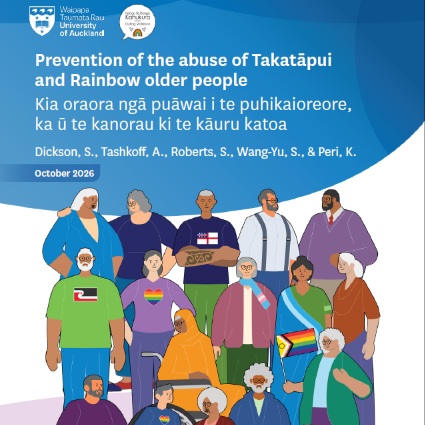
This research report is a collaboration between the University of Auckland and Hohou Te Rongo Kahukura. The report focuses on the prevention of abuse of Takatāpui and Rainbow older people, which includes physical, sexual, financial, psychological, cultural, and spiritual harm, and neglect.
The first research of its kind conducted in Aotearoa, this report comes alive through more than 150 quotes from interviews with community experts.
The report includes:
- A comprehensive review of international and national research literature
- An analysis of how the current New Zealand abuse of older people (AOP) system and policy context addresses the needs of Takatāpui and Rainbow older people
- An exploration of the differences between diverse groups within Takatāpui and Rainbow communities via ten community expert interviews.
We identified an urgent need for systemic change to uphold the dignity, safety, and wellbeing of Takatāpui and Rainbow older people in Aotearoa New Zealand, and prevent and respond effectively to abuse.
- Takatāpui and Rainbow older people experience specific identity-based harm in healthcare, aged-residential care (ARC), and social services.
- Family rejection, estrangement, and lack of acceptance is common.
- Cumulative minority stress is a significant barrier to help-seeking.
- Takatāpui and Rainbow older people need inclusive, culturally specific, and competent support.
- Takatāpui and Rainbow older people are often unacknowledged in key AOP systems, strategy, and policy documents. Most documents fail to mention Takatāpui and Rainbow older people at all. Where relevant content exists, Takatāpui and Rainbow older people are most likely to appear within a list of marginalised communities.
- Specific, tailored AOP services and resources must be developed for Takatāpui and Rainbow older people.
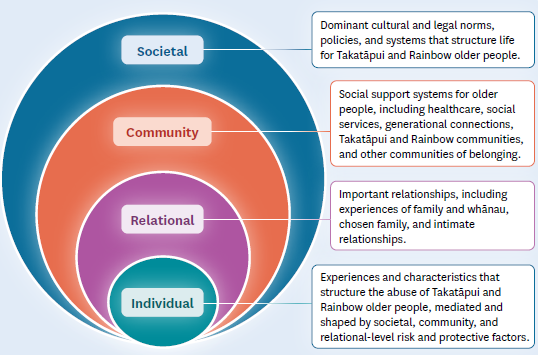
We can do so much better! At societal, community, relational and individual levels, there are opportunities to increase protective factors and reduce risk factors of the abuse of Takatāpui and Rainbow older people.
Takatāpui and Rainbow older people experience much higher rates of abuse than other older New
Zealanders, often facing identity-based harm stemming from colonisation and the legacies of
criminalisation and pathologisation.
The report presents twenty-four recommendations to improve AOP prevention and response services for Takatāpui and Rainbow older people, with a focus on increasing immediate safety, expanding supports and help-seeking pathways, and supporting systemic change.
Tailored support would enhance social connections and reduce isolation, critical to preventing and responding to the abuse of Takatāpui and Rainbow older people.
Short-term key priorities to increase immediate safety:
- Resource community-led AOP prevention, and response services designed specifically for Takatāpui and Rainbow older people.
- Develop tailored and culturally diverse resources for Takatāpui and Rainbow older people, families, and whānau on ageing well, healthy relationships, legal protections and complaints processes, and digital safety.
Takatāpui and Rainbow older people need their identities, histories, and relationships to be treated with respect in healthcare, social services, and community settings.
Medium-term key priorities to expand supports and help-seeking pathways:
- Develop foundational training for housing, healthcare, and social services professions to improve Rainbow competency.
- Invest in Kaupapa Māori and culturally specific research, services, and workforce development for Takatāpui and Rainbow older people.
- Develop policy-driven and culturally safe Rainbow competency standards in housing, healthcare, ARC, and social services, accompanied by commitments to professional development and capacity building towards respectful practices.
- Strengthen and promote effective and independent complaints processes for state agencies and state funded housing healthcare, ARC, and social services to improve systemic accountability.
By leveraging off short- and medium-term shifts that support immediate safety, longer-term priorities address entrenched inequities and strengthen the evidence base, supports, and services for Takatāpui and Rainbow older people.
Longer-term key priorities to support systemic change:
- Establish leadership on Takatāpui and Rainbow community issues within government and improve data collection guidelines and standards.
- Increase research funding and ensure the visibility of Takatāpui and Rainbow older people in national campaigns to reduce ageism.
- Ensure access to adequate income for Takatāpui and Rainbow older people, including reviewing the residency status requirement for New Zealand superannuation, which has specific, negative impacts for older migrant Rainbow people.
This research sits within the Prevention of abuse of older people work programme, led by the Ministry of Social Development | Te Manatū Whakahiato Ora.
Within the same programme, the national prevalence survey of those older than 55 living in the community found Takatāpui and Rainbow older people were nearly twice as likely as the general older population to report experiencing harm in the last 12 months, due to the compounding effects of discrimination, marginalisation, and exclusion over time. Financial harm (14% cf 3.8%), cultural and spiritual harm (12.8%
cf 3%), and physical harm (10.1% cf 2.6%) were all experienced at four times the rates of the general older population. AOP is also layered over higher lifetime rates of partner violence and sexual violence for Takatāpui and Rainbow communities.
We mihi to the wider Hohou Te Rongo Kahukura whānau, the wider University of Auckland team and our funder, the Ministry of Social Development | Te Manatū Whakahiato Ora (MSD), for enabling us to highlight the needs of Takatāpui and Rainbow older people experiencing abuse.
Our final mihi is the community experts we interviewed, for their generous sharing of lived and professional experiences of Takatāpui and Rainbow older people. We are committed to ensuring the needs of older people are visible and prioritised within Takatāpui and Rainbow communities, and across every service, policy, strategy, and programme for older people in Aotearoa.